Uganda to Reintroduce Female Condoms

Author image

"When a man comes up with excuses for not using a male condom, women have a right to introduce their own tool for protection."

-- Deusdeait Kiwanuka, Project Coordinator, Safe Homes and Respect for Everyone (SHARE) 

Deusdeait's words poignantly capture a major challenge in fighting HIV/AIDS: to ensure women have access to prevention tools designed to put them in charge and give them an opportunity to initiate protection.  Enter the female condom - the only safe and effective prevention tool that is designed for women to initiate and is available for use NOW.  But "available for use" doesn't necessarily translate into "accessible to women" - whether in the U.S. or abroad.   

Consider Uganda, where the Ministry of Health reports that 76% of the country's new infections are sexually transmitted and women make up 60% of those infected.  Moreover, 42% of new infections occur in marital sex.  These sobering statistics cry out for expanding prevention options that put women in the driver's seat.  Despite this, women and their partners currently have no access to female condoms in the country. 

Fortunately, the tide is turning for women, men and youth who could benefit from the female condom.  The Ugandan government plans to reintroduce and promote the female condom this fall, and civil society leaders in Uganda see this as an opportune moment to accelerate investment and support in this initiative.  

Last week, the Center for Health and Gender Equity (CHANGE) and the Global Campaign for Microbicides (GCM) - both US-based organizations advocating for the availability and accessibility of a range of prevention options for women worldwide - convened local leaders from HIV/AIDS, reproductive health, domestic violence, human rights and women's rights groups in Kampala for an advocacy training targeted at donors and national government to ensure successful reintroduction of female condoms in Uganda. As part of the training, participants met with members of the Health Development Partnership Group, which USAID heads; with UNFPA and the Ministry of Health, demonstrating civil society support for the prevention method.  Participants also learned about the history of the female condom in Uganda and how to move forward with advocacy efforts beyond the training. 
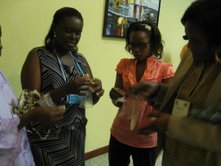
The training was opened by Mr. Benard Mujuni of the Ministry of Gender, Labour and Social Development, who made the case for women's access to currently existing prevention methods such as female condoms - and future products such as microbicides - as a human rights and reproductive rights issue.  But in order for female condoms to succeed today, in Uganda and elsewhere, civil society must be full partners in any launch or rollout of female condom programming.   

Vastha Kibirige, coordinator of the condom unit at the Ministry of Health, underscored this point by providing an overview of the Ministry's situation analysis of the female condom in Uganda that was released earlier this year.  Kibirige explained how the first introduction of female condoms in Uganda in 2000 was not successful, but this was not because of the product. Civil society was not actively engaged in the first rollout of female condoms, and a lack of resources and sustained support for distribution, education and programming, made the existence of the product useless.  

Accessibility issues explained by Kibirige posed very real problems for many women.  For example, a participant from the Center for Domestic Violence Prevention recounted how domestic violence fuels women's requests for female condoms in situations of martial rape.  Sometimes, when these women are able to negotiate condom use, men come up with excuses or resist using male condoms.  Her clients say that if they had female condoms with them, they could put them on before they have sex, giving them an additional tool for negotiation and protection.

This is not to say that female condoms are a magic bullet or that access alone will ensure successful use and uptake.  But the group did highlight the concept of "universal acceptability" - a different way to think about and advocate around female condoms.  This frame calls for removing stigma and biases often associated with female condoms, allowing men, women and youth to freely choose female condoms as a legitimate prevention option.   

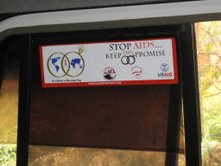
Finally, against the backdrop of our discussions around women's high risk of infection from marital sex and lack of access to female condoms, it was interesting to note PEPFAR's abstinence and fidelity impact on Uganda.  In our shuttle bus to meet with USAID and other donors in the Health Development Partnership Group was a bumper sticker with wedding rings, stating "Stop AIDS. Keep the Promise," "Be Faithful in Marriage."  It's clear that much more work needs to be done. 
Let's hope the Obama administration, especially the new global AIDS coordinator and USAID administrator will turn the tide for women and men and young people in Uganda by supporting the Ministry of Health's efforts to save lives by making female condoms accessible. 
. . . . . . . . . .
. . . . . . . . . .
6 comments
Please login or register to post and rate comments...
Comments are rated by readers on a scale from 1 to 5. Comments with a rating of 2 or less are hidden. Click on hidden comments to view them.
0
Anonymous Female Condom Study . . . June 29, 2009 - 12:03pm

We have developed a new female condom concept intended to be more attractive and pleasurable for both partners. The "ORIGAMI FC" has a 'no-fumble' method of insertion that is quick and easy to use. We anticipate R&D funding in Nov 2009 and plan to commercialize it by 2016.

As with the Reality brand FC1 and FC2, the R&D is quite lengthy and it will cost several million dollars. In the meantime, we wholeheartedly support the expanded global promotion, distribution and use of the new FC-2.

We believe that the ORIGAMI FEMALE CONDOM will eventually set a new global standard and become the preferred condom for BOTH men and women, which could surpass male condoms 3 to 1 by 2022.

Researchers interested in using the ORIGAMI FC for US or international FC studies are encouraged to contact Dan Resnic; Email: resnicpi@gmail.com - TEL: 1-310-305-2984 in Los Angeles, CA , USA - or by Skype: danindesert .

0
Coca Trillini Derechos humanos de las mujeres June 30, 2009 - 10:01am

Hola Serra,
compartimos que el derecho a una sexualidad placentera debe estar lejos de correr riezgos de vida para las mujeres. Es interezante el trabajo y el informe sobre Uganda donde podemos encontra similitudes con las situacion de las mujeres en America latina. Sigue siendo una cuestion de voluntad politica cuidar la vida de las mujeres.
cariños, Coca Trillini.

0
Om Garg New Female Condoms Available June 30, 2009 - 10:06am

Cupid Ltd. has developed a unique latex based female condom which is user friendly and less expensive than the currently available female condoms. People interested to learn more about this new product, marketed by Cupid, should contact Om Garg at Email- Omramtrading@att.net
phone number (440) 331-7946

0
Amy Kaler Documentation of lessons learned from FC 1 June 30, 2009 - 11:08am

Hello,

Those involved in the Ugandan re-launch of the female condom may be interested in two research articles I wrote documenting issues which arose during the distribution and promotion of the first female condom in Africa in the late 1990s-2000s. These articles are "It's some kind of women's empowerment: The ambiguity of the female condom as a marker of women's empowerment" (Social Science and Medicine 52, 2001) and "The future of female-controlled barrier methods for HIV prevention: female condoms and lessons learned" (Culture, Health and Sexuality 6:6, 2004). The latter contains some material from Uganda. If anyone is interested in these articles but unable to access them, please let me know by email and I'll be glad to send you a PDF. I am very interested in the possibilities of female barrier methods to provide women with greater control over their sexual and reproductive risks, so I'm happy to hear that the FC2 is being re-launched in Uganda. Best wishes for success, Amy Kaler

0
Om Garg We are interested to have a July 2, 2009 - 9:56am

We are interested to have a copy of your 2004 article about FC1 use in Uganda.

Also we are keen to participate in the distribution of Cupid's Latex based female condoms at competitive price.Please let us know how we can participate?

Thank You
OM GARG Cupid Ltd. Manufacturer of Female Condoms
Cleveland Ohio

0
Kindyomunda The training was indeed an July 15, 2009 - 11:45am

The training was indeed an important event for the advocacy for the female condom in the country and well timed considering that MoH is finalizing the situational analysis and operational plan. The female condom does need intensified, concurrent and positive promotion from different key stakeholders (government, civil society and development partners) to influence policy and prioritization at planning and budgeting levels, but mostly to promote acceptability among females and males for increased uptake and reduce stigma and biases. There is need to demonstrate demand for this technological method to influence programming. And civil society organizations (CSOs) are best suited to establish this demand and lobby through different planning fora in the health and HIV/AIDS worlds for priority focus on the FC.

As we intensify this advocacy, the following issues that came from the discussions during the training need to be addressed:
• CSOs need to be fairly familiar with the government systems (and politics) especially for planning and budgeting processes to achieve results from advocacy efforts. Workshop participants for example had the perception that donors can directly influence government to prioritize issues - an impression that was fortunately corrected during consultations with donors and Ministry of Health. CSOs need to participate in evidence generation efforts including documenting demand and take lead in advocating for some aspects as national partners to provide the basis on which donors can also take on issues
• Similarly, CSOs need to proactively identify entry points but also be supported to ensure their participation in key policy and planning fora. Often the nature of CSO representatives in different fora do not represent actual issues as obtaining in the constituencies - due to poor consultations and sometimes lack of interest in specific issues
• Advocacy for the Female condom needs to take into perspective the dual protection aspects to avoid skewed communication and public understanding. Whereas the currently parallel RH and HIV worlds can potentially intensify advocacy for FC for better results, poor coordination between the two to ensure message consistency might lead to biased perspectives about FC with limited desired outcomes at individual and programming levels. There should not be a repeat of the male condom situation that has largely been promoted from the HIV perspectives. As such the Ministry of Health and the Uganda AIDS Commission need to be targeted concurrently to utilize both planning process until RH/HIV integration concepts take root in the country.
• Similarly, all care must be taken to ensure that the FC is not promoted as a magic bullet. In a country where Ministry of Health reported (in 2005) 92% of couples are HIV negative concordant, featuring HIV in the remaining 8% of couples (HIV+ concordant or discordant), it might be unrealistic to expect that FC will take the place of other prevention measures such as couple testing and being faithful. As such, our FC advocacy needs to be well positioned in the nationally agreed HIV Comprehensive Prevention Package, ensuring tailored prevention interventions to specific environments around individuals.
• As we promote the FC, we also need to learn from experiences from promoting the male condom in Uganda. While widely accepted in Uganda and relatively accessible, male condom use in long term sexual relationships is as low as 5%, yet this is where most new HIV infections are occurring. Consistent condom use is challenge even with the documented concurrent multiple sexual relationships. Most social, cultural, religious and economic factors that influence male condom use will also impact on FC use and need to be anticipated. Indeed FC promotion should not be delinked from male condom promotion but be used to provide opportunities for couple choices
• To an extent the FC is a male condom! The gender inequality issues and lack of negotiation skills for condom use on the side of females are still with us. The FC alone will not provide the needed empowerment to the female partner. Advocacy for comprehensive programming to focus on gender roles, norms and expectations in different settings is still key.
The training ended on a very positive note - the formation of an FC advocacy coalition that should ignite action in the civil society world. We however need to ensure that the fears raised by participants on what can easily kill this innovation (e.g. turning it into an organization, poor mobilization of other CSOs that did not participate, lack of transparency, and advocacy/activism that is not evidence based) are systematically addressed. UNFPA pledged to provide technical support and meeting room where necessary in the formative stages