
Rewire Interviews: Donna Dickenson, Author of “Body Shopping”
"Body Shopping" author Donna Dickenson draws a connection between "beauty junkies" and bone thieves, and asks the reader to consider the consequences of transforming the human body into a sellable object.
Donna Dickenson is an author,
activist, and academic working in the field of medical ethics. Her impressive
resume includes being Professor Emerita of Medical Ethics and Humanities at the
University of London, coordinating research projects for the European
Commission, and winning the prestigious Spinoza
Lens prize for demonstrating critical ethical reflection in her work. (She
shares the latter honor with the late theorist Edward Said.) Her compelling, thoughtful, and extensively researched
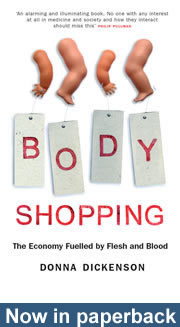
Body Shopping:
Converting Body Parts to Profit, is recently out in paperback. Dickenson walks the reader through complex legalese and medical
research to reveal the ways in which human tissue has been commodified and can
now be "bought and sold on international markets." Her chapters address a broad
range of topics, from the ethical dilemmas intrinsic in the recruitment of
women for egg donation to the fantasy and reality behind "repair kits"
generated from umbilical cord stem cells, to how building designer babies
revisits centuries-old arguments about eugenics. Dickenson draws a connection
between "beauty junkies" and bone thieves, and asks the reader to consider the
consequences of transforming the human body into a sellable object.
Mandy Van Deven: I learned an enormous amount about the current
ethical and legal struggles in the medical field from reading Body Shopping; the book is packed with
information that isn’t readily available to the public. What influenced you to
write such an expansive and accessible book?
Donna Dickenson: In 2006
I won an international award called the Spinoza Lens prize, which is given for
contribution to public debate on ethics. At that point I had written some sixty
journal articles and twenty academic books, but the prize organizers felt I
could do even more to bring my concerns to a wider public. So that was my
inspiration to write a book that could be classified as either popular science
or current affairs, for a general audience.
To be modest, much
of the factual information you mention has actually been put before the public
by investigative journalists and academics. My contribution was bringing my
legal and analytical skills to find common threads between the very wide range
of sources I’ve used: there are about 400 articles and books in my bibliography.
I also put forward proposals for reform which haven’t penetrated much beyond
the academic literature, and I situate the problem in its historical context,
as well as offer a new way of looking at it in terms of the way "we all have
female bodies now."
MVD: What does it mean for everyone to have a "female body?"
DD: It’s not
that we all have biologically female bodies, but that all bodies are now seen
by commercialized biotechnology as "open-access." That means we can learn a lot
from the criticisms feminists have offered of the ways in which women’s bodies
have been turned into objects.
MVD: In
the book you remind us that advertising has long objectified and commodified
women’s bodies and point out the gendered ways women are more susceptible to
exploitation and bodily risk through egg "donation," cosmetic surgery, organ
donation, and umbilical cord blood banking. It seems somewhat ironic that a
culture can devalue women socially yet place such a high literal price on
women’s bodies. How does this coupling of oppositional value contribute to the
higher rates of body shopping for women?
DD: Women’s tissue is generally more valuable
than men’s: eggs fetch higher prices than sperm, for example – but that’s got everything
to do with anatomy and not much to do with advertising. So when I say that all
bodies are becoming "feminized," becoming objects of commercial interest, I
qualify that by adding that women’s tissue remains more valuable.
Cord
blood, which has a large number of stem cells that are used to treat several
illnesses, is generally presented as belonging to the baby, but the advice received
by the Royal College of Obstetricians and Gynaecologists’ internal legal
counsel held that it was the mother’s. I agree with that position because of
the extra work and risk the mother puts into having the blood taken and stored
during delivery.
In
cord blood harvesting, the blood is taken from the mother’s side of the clamp, frequently
while the cord is still attached to the maternal placenta. Extra effort and
risk-taking are put into "harvesting" the cord blood by the mother, and
normally we think of labor and risk-taking as what justify property rights. There
is work involved here because the blood isn’t just leftover waste. The only reason for thinking
it’s the baby’s is its genetic basis, but we don’t normally think of genetic
identity as the basis for property rights. At the very least, we ought to
be thinking about whether it belongs
to the mother, rather than just assuming it belongs to the baby, as most
commentators have done.
MVD: You also
argue body shopping disproportionately harms people of color, individuals and
nations with less wealth, and other marginalized populations, like prisoners.
Can you talk a little about that?
International
organ and egg tourism does exploit people in poorer countries. There’s a good
article in the Hastings Center Report this month showing the way in which
payment for kidneys – often sold to wealthy foreigners – has become a major
industry in Pakistan, where the sellers are inevitably the poorest peasants,
who remain in debt afterwards because the broker or moneylender who arranges the kidney
sale takes such a large part of the proceeds, or because the debts exceed the
low price they can obtain for their kidney, and also in worsened
health. All but one of the Pakistani sellers surveyed said they would never
advise anyone else to do what they had to do out of desperate poverty. The
authors think that Westerners who justify organ and egg sales as "free choices"
by the sellers are both cynical and naïve, and I have to say that’s the
dominant position in the bioethics literature. I like to think I’m an honorable
exception!
MVD: It can be difficult to wrap one’s head around some of the contradictions in "body shopping"-like
the fact that we don’t own our own bodies so we are not able to sell our organs
for a profit (at least, not in the United States), yet when we die our organs
can be sold to medical facilities by the medical school it was donated to and
we can be compensated for some of our
"parts," such as eggs and sperm.
DD: People are always surprised that we don’t own
our bodies in law, but the traditional common law position was that once taken
from the body, tissue was "no one’s thing." That didn’t pose any problems,
because before the rise of modern biotechnology, there was little or no value
in the tissue-which would probably have been removed [only when] it was diseased.
The older legal position still holds in the US Uniform Anatomical Gift (1987),
which makes it illegal to sell organs – except for eggs and sperm, which were
exempted as renewable tissue. That medical error – sperm is renewable, but eggs
actually aren’t – has given rise to a vast egg-buying and egg-selling industry
in the US, which isn’t
replicated in most European countries, with the exception of Spain and Cyprus.
Your
organs can’t legally be sold without your consent when you die, but I think
many people would be surprised at the alleged onward sale of parts of bodies
donated freely under willed-donor programs, as is said to have occurred at
several US
medical schools.
MVD: The specialized nature of the knowledge surrounding body
shopping (legal, scientific, medical) seems to makes these industries
particularly ripe for corruption and misuse. How can this type of information
be disseminated to a lay audience?
DD: My goal in
writing the book was to take these developments out of the scientific or academic
literature and describe them for a non-specialist audience. I’ve had a lot of
experience in writing texts, as well as appearing on TV and radio to talk about
medical ethics, which helped a great deal. I think the greatest difficulty
isn’t so much that a popular audience can’t easily understand the science and
medicine, but that we live in a very polarized society. Anyone who isn’t one
hundred percent behind every new development in biotechnology is often
portrayed as either ignorant or doctrinaire – frequently, at least in the UK, as a
religious zealot.
Many people have
been persuaded – falsely – that’s if we want the genuine benefits that modern
biomedicine can bring us, we have to accept all the scientific developments
uncritically. So the difficulty is getting a "lay" audience to "lay" aside this
presumption that "you’re either with us or against us" and accept that you can
be entirely pro-medicine – as I am, having spent my academic life working with
doctors-but also concerned about the ethical issues. I try to present both
sides of the ethical and legal arguments for and against commercialization of
the body throughout the book, and to play devil’s advocate to my own views.
MVD: There seem to be two dichotomous arguments regarding body
shopping: abolish the practice or let the market/individuals decide. Both are
impractical and will not abolish the black markets and other abuses that exist
internationally. Do you think a middle ground is possible?
DD: Yes, in the sense that I think body shopping
can, and should, be regulated-although that will also involve outlawing some of
the worse developments altogether. Letting the market decide just isn’t
tenable. Particularly after the collapse of major banks and firms like General
Motors following the sub-prime mortgages lending disaster, we’ve seen that
total market deregulation isn’t a practical choice. There can’t be very many
extreme free-marketers left out there; the argument that "you can’t buck the
market because the market is always right" is clearly untenable when markets
are imploding. In any case, many of the new developments in biotechnology, like
mapping the human genome, were largely paid for out of public money. It’s only
right that the public and the state should have a role in regulating both the
profits and the practices.
MVD: And
privatizing the market can actually have negative consequences on the
progression of medical research.
DD:
I’m very worried that medical progress is being hampered by the way in which
the body has become a product. For example, because one in five genes is now
under patent restriction, medical research teams often can’t carry out
much-needed studies unless they pay a license fee to the private company that
holds the patent – if the company will allow access at all. Commercialization of
the human body isn’t always necessary to medical progress, and in some cases
it’s actively bad for science.
MVD: It seems like regulation and legislation are always lagging
behind when it comes to body shopping. Why is that?
DD: It’s difficult for law and regulation to keep
up with the sheer pace of scientific change, but not impossible where the
political will exists. I think the difficulty is that often it doesn’t exist,
partly for the reasons I’ve given already: the assumption on the political Left
that science is always a progressive force, and the belief on the Right that
markets are never wrong. So when you have massive market investment and
commercialization in bioscience, people on both sides of the spectrum assume it
must be a good thing.
MVD: Do you have any suggestions for shifting this dynamic?
DD: The first step is to make people aware that
commercialization can be actually be bad for both science and individual
patients. The example of private cord blood banks is very telling: here in the
UK the Royal College of Obstetricians and Gynaecologists has put out two
reports showing
evidence that while public banking is beneficial, private commercial
banking is potentially harmful. We now have a UK government body called the Human
Tissue Authority that regulates the private banks by requiring them to register
and to pass certain tests for a license.
There
are a number of legislative moves afoot throughout Europe, and also in the US,
China, and India – although all three of those countries do have large private
markets in egg sales, now on an international scale. There are also very active
pressure groups like the Corner House or Genewatch in the UK, the Centre for Genetics and Society in California, and Korean Womenlink,
as well as a number of alternative models-like benefit-sharing or pooled gene
patenting – where patient groups share the profits from discoveries with
biotechnology companies. And there’s the very important new court case against
the expensive license fees that patients have to pay on genetic patents on two
genes implicated in some breast cancers, which was launched by the American
Civil Liberties Union and other concerned groups.
I believe egg sale – it should be
called "sale" rather than "donation" – should be prohibited. The only reason the
vast market arose was due to the physiological misunderstanding underpinning
the US Uniform Anatomical Gift Act. The Act wrongly assumed that eggs are
renewable tissue like sperm, but it’s generally agreed that a baby girl is born
with all the egg follicles she’ll ever have. It would be consistent with the
reasoning in the rest of the Act to include eggs with non-renewable organs and
prohibit their sale. All European jurisdictions except Spain and Cyprus do just that.
MVD: When Body Shopping
was initially released some people used words like "horrifying," "shocking," "disturbing,"
and "alarming" to describe it. Did you expect to elicit such strong reactions?
DD: I did not set out to
shock, horrify, disturb or alarm, but to explore the ways in which modern
biotechnology is commodifying areas of our life from BC (before conception) to
AD (after death), and what we can do about it. My background as a professor of
medical ethics and law, and as someone who has taught generations of medics and
nurses, makes me practically minded. Instead of focusing on the sensational
cases, I concentrate on everyday instances of "body shopping," like the
patenting of human genes which forces patients to pay a license fee for
diagnostic tests, or the development of private umbilical cord blood banking,
which has been described by leading medical bodies as potentially dangerous for
both mother and baby.
Fay
Weldon said Body Shopping was
written "gently, thoroughly and reasonably calmly," and I was particularly
pleased that The Lancet and New Scientist said I’d got the
science and medicine right – that the book was objective and accurate. I think it
would be a mistake to portray the book as sensationalistic. That said, people
are genuinely shocked by such events as the illegal sale of bones from funeral
homes, or the scale of the international organ trade. I don’t want to denigrate
such reactions – their heart is in the right place – but I would be dismayed if
they diverted attention away from the much more widespread and less
sensationalistic instances of "body shopping," which are the main subject of
the book.