
Sex And The City: Eww It’s For Girls!
There was no way a two-hour film version of "Sex and the City" would live up to the complexity of the six-series-long show. But did half the characters need to be so flat, and the show's attempt at racial diversity such a misfire?
With a flutter of tulle and a flash of bejeweled stilettos,
women made history this weekend. We showed up at theaters, beat up Indiana Jones, and demanded that our
power as an audience be recognized. If only Sex
and the City: The Movie had lived up to the TV show that inspired the
box-office barnstorm. But that’s a tall order — this is Hollywood after all. Photo by Keepin’ On
Of course, the SATC
backlash was underway before the movie premiered: eww,
it’s for girls, the pundits declared. But box office numbers proved the
sexist naysayers beyond wrong. It couldn’t just have been Manohlo-clad,
Cosmo-swilling party gals buying tickets–there aren’t that many of them.
Attendees most assuredly included dudes, moms and daughters, the un-glamorous,
and plenty of feminists.
After all, the show’s brand of feminism was as important to
its success as outlandish outfits and sexual positions. Sex and the City’s
heroines make widely divergent choices ("I choose my
choice!" aspiring housewife Charlotte shouts at working gal Miranda during
one memorable episode). Women viewers know it can be painful in real life for us to face up to those who
live differently, the Charlottes to our Mirandas. SATC allows its characters to
feel the omnipresent judgments and conflicts in women’s lives, and feel them
deeply, in a way that resonates with truths about modern womanhood. But then,
as the arc or episode draws to an end, the four characters always accept each
other. That kind of unassailable sisterhood is a feminist ideal, even when
accented by silly designer shoes.
WARNING! SPOILERS BELOW
Of course, there was no way a two-hour mainstream film would
live up to the complexity of the show, which built these themes into six
seasons and countless storylines. The film’s best moments come after Carrie is
pseudo-jilted at the altar, and our four heroines spend a healthy chunk of time
onscreen together, trading the kind of insight and banter that made the show so
much fun.
Throughout the film, all four stars remind us that they have
real acting chops, but Kim Cattrall as an older, more monogamous, and less
happy Samantha shines the brightest. Samantha’s struggle between her genuine
love for her hunky movie star boyfriend and her desire to be independent and
free is actually quite poignant and multi-dimensional, and gets to the heart of
the show’s themes. And Sam’s biting one-liners break the onscreen tension
without sacrificing emotion, providing the best humor in the film. "Oh, honey, you made a little joke," she says to the
catatonically-depressed Carrie who has shown the energy to muster a bad
pun about her "Mexicoma." Catrall is hilarious, but she also shows how
deeply attuned these women are to each other. (So for everyone who moaned about Catrall
holding out for a better paycheck, she deserved it!). I usually prefer Miranda
to Samantha, but I thought Catrall was given the most subtle and meaty
material, and she tackled it with relish.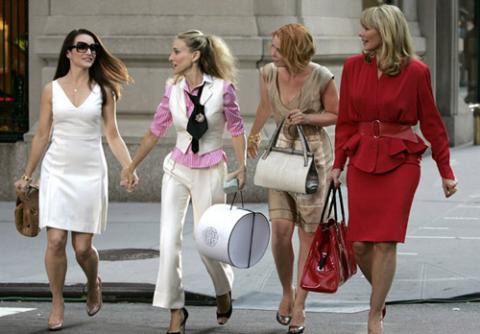
As wonderful as it felt to greet Samantha and her crew, and
as much as the audience at my screening laughed, sobbed, and hollered at the
screen, the movie had some big disappointments. The first one, which has been
widely noted, was the subplot with Jennifer Hudson, taking
the "Magical Negro" stereotype to a new level. Hudson, as Carrie’s
assistant Louise, waltzes in, literally helps Carrie clean up her
post-breakdown mess, gives her a special "love" keychain, and then disappears
back to St. Louis once
Carrie doesn’t need her anymore. Despite truly gargantuan acting efforts by
both Sarah Jessica Parker and Hudson during their scenes together, it shocks me
that the producers and writers didn’t try harder to throw some window dressing up around Louise’s
tokenization (memo: it’s not that tough: give her some sex scenes, some talent
beyond organizing white women’s lives), even if they wouldn’t put the effort into turning her character into someone real. But mere window dressing wouldn’t be close to enough. It may have seemed daunting to create three-dimensional secondary
characters in a two hour film, but shouldn’t the filmmakers be smart
enough to realize what an unfortunate pattern they were playing into?
The film’s second significant disappointment was in its portrayal of the characters
of Miranda and Charlotte. Both characters, more realistic New Yorkers than
their counterparts, actually grew during the course of the series. Miranda
transitioned from a too-tough, too-vulnerable go-getter to a more balanced and
happy person, while Charlotte let go of her dreams of porcelain domesticity and
found a nebbishy but beloved husband and an adopted daughter. In light of those histories,
both of these women deserved
better storylines than the film gave them: is Charlotte really beatifically
content with the life of an Upper East Side wife? Can’t Miranda ever be given a
moment to be proud of her achievements without snapping, or being punished, as
a result of them?
It’s no surprise that the movie didn’t live up to the show,
nor is it a surprise that it was such a huge hit anyway. Women, and men of color, are inured to enjoying films with problematic elements, because otherwise we’d
never see movies at all. Despite my own critiques, it was exhilarating to be surrounded by mostly women and hearing the laughter, tears and cheering. Let’s
hope that the triumph of this film, combined with that of Juno, means that there will more smart
movies for women. But more importantly, let’s hope that it gives Sex and the City II, and other movies of
its ilk, license to be more risky, to be more real, and to include racial diversity
that’s more than just a gesture.